
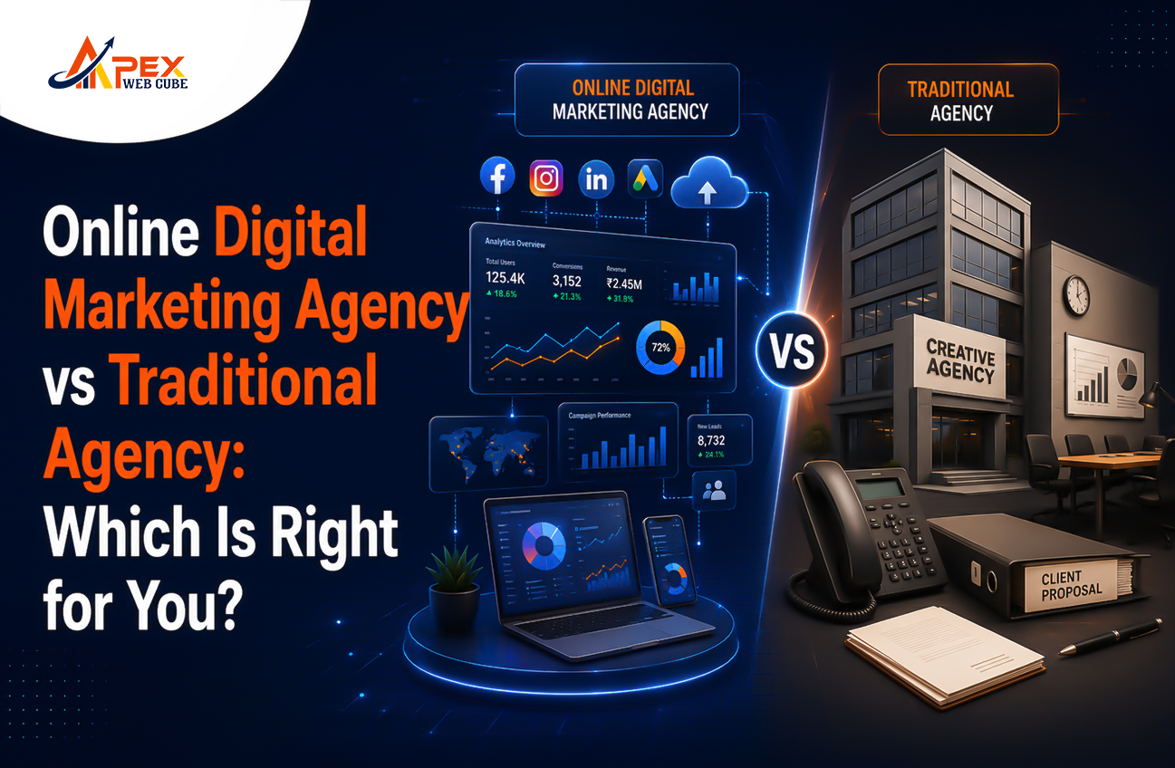
A small business owner in Ohio spent on billboards last year and couldn’t tell you how many customers it brought in. Meanwhile, her competitor spent a third of that on a Digital Marketing Agency USA based team and could point to exact numbers, clicks, calls, conversions, all of it. That gap right there is basically the whole story of this article.
Here’s what you’ll walk away knowing by the end: how online and traditional agencies actually differ in practice, what each one is genuinely good at, and which one fits your business depending on your goals, budget, and honestly your patience level too because some of this comes down to personality as much as strategy.
Key Takeaways
- Digital campaigns can be adjusted within hours, traditional media usually cannot be touched once it airs
- A Best Digital Marketing Agency relies on measurable data, traditional agencies often work on estimated reach
- Traditional media still has a role for local branding and certain regional businesses
- Cost of entry is far lower with digital, making it more accessible for small and mid-sized businesses
- The right choice depends on budget, audience, and how fast you need results
Table of Contents
What Is a Traditional Marketing Agency?
Traditional agencies grew up around print, TV, radio, and direct mail. Think full-page newspaper spreads, thirty-second commercials, billboards along the highway. Plenty of them still do solid work, especially for brands that need heavy local visibility.
The catch is measurement. Run a radio ad for three months and you get a vague sense sales went up, but proving the ad actually caused it is nearly impossible without expensive tracking studies. Many traditional contracts also lock clients in for six months or a year before anyone even knows if it worked.
What Does an Online Digital Marketing Agency Do?
Online agencies work across SEO, paid search, social media ads, email, and content marketing, all on platforms that track everything down to a single click or scroll. This is where accountability really took over. Businesses searching for a Digital Marketing Agency USA-based team usually want that kind of transparency from day one.
Take a mid-sized ecommerce brand as an example. A digital-first team might restructure Google Ads based on real conversion data instead of guesswork, cutting wasted spend by simply dropping keywords that never converted. Traditional media has no equivalent mid-campaign fix.
Traditional vs Digital: Key Differences
Factor | Traditional Agency | Online Digital Agency |
Speed of adjustment | Locked in once it airs | Can change within hours |
Cost entry point | High, media buys are expensive | Low, scalable ad budgets |
Targeting | Broad, hopes right people notice | Precise, by location, age, interest |
Measurement | Estimated reach, hard to prove ROI | Exact clicks, calls, conversions |
Trust building | Brand recall over time | Reviews, rankings, organic credibility |
When Does Traditional Still Make Sense?
Not every business should drop traditional channels completely, and saying digital always wins would be a bit dishonest. Local service businesses, certain B2B industries, and brands with strong regional identity sometimes still benefit from a mix. A roofing company in a small town might genuinely get value from a local radio spot that builds recognition over years.
For businesses expanding into new territory, this gets more layered too. A company scaling into new provinces might work with a Digital Marketing Agency Canada team specifically because regional search behavior, language preference, and local trust signals matter more than people expect. What works in Texas doesn’t automatically translate to Toronto.
How Do You Choose the Right Fit?
- Check your budget first. Limited funds mean digital gives more room to test and adjust without burning cash on unproven media buys
- Think about your timeline. Need results this quarter? Digital moves faster. Building long-term brand recall over years, traditional media can still play a part
- Look at your audience. Younger, tech-savvy buyers live online. Older, local demographics might still respond to print or radio in specific markets.
What Mistakes Should Businesses Avoid?
- Expecting overnight rankings or guaranteed viral content from a digital agency; real SEO takes months to build momentum
- Assuming traditional media guarantees brand recall without any way to measure it
- Picking an agency purely on price without checking what’s actually being tracked and reported
- Treating this as either-or when a blended approach sometimes works better
How Do Costs Compare Over the Long Run?
This is where a lot of business owners get surprised. Traditional media costs tend to stay flat or even climb; a billboard rate doesn’t drop just because your campaign has been running well, and TV airtime prices shift with the season regardless of your results. Digital works differently. Once an agency has enough data on what’s converting, the cost per lead usually goes down over time because the guesswork gets removed. Ad spend gets redirected away from what isn’t working and into what is. It’s not instant; it takes a few months of testing, but the trend line moves in your favor instead of staying static. A Best Digital Marketing Agency will actually show you that trend rather than just promising it exists.
What Role Does Content Play in Each Approach?
Traditional agencies treat content as something you produce once, a script, a print ad, a jingle, and then run repeatedly until the budget runs out. Digital flips that completely. Content keeps working long after it’s published; a blog post from eight months ago can still be pulling in traffic today if it was built around the right search intent. That’s part of why SEO content and organic visibility have become such a core piece of digital strategy; it compounds instead of expiring. Traditional ads stop the second the media buy ends, but a well-ranked page or a piece of content that keeps getting cited does not just disappear. For businesses thinking long term, that difference alone changes how the budget conversation should go.

Conclusion
For most modern businesses chasing measurable growth, digital agencies offer speed, precision, and cost control that traditional media structurally cannot match. Traditional still holds value for local branding and certain regional strategies, but it rarely stands alone anymore.
The businesses that win long-term tend to stay flexible and lean into data rather than pure guesswork. If you’re weighing this decision seriously, Apex Web Cube works with clients to figure out exactly where that balance should sit.
FAQs
What makes a digital marketing agency different from a traditional one?
Digital agencies focus on trackable, adjustable channels like SEO, paid ads, and social media, while traditional agencies handle print, TV, and radio, where results are harder to measure in real time.
Is it worth hiring a Digital Marketing Agency USA based team over a local freelancer?
Agencies typically bring a full team, strategists, designers, and analysts, which tends to produce more consistent results than a single freelancer juggling everything alone.
How do I know if I need a Best Digital Marketing Agency versus a traditional one?
If measurable ROI, quick adjustments, and precise targeting matter most to you, digital is usually the better fit. Traditional still works for certain local or brand-building goals.
Can a Digital Marketing Agency Canada team help with expansion into a new market?
Yes, agencies with regional experience understand local search behavior, competition, and cultural nuances that a generic strategy often misses.

